Quick answer
In short
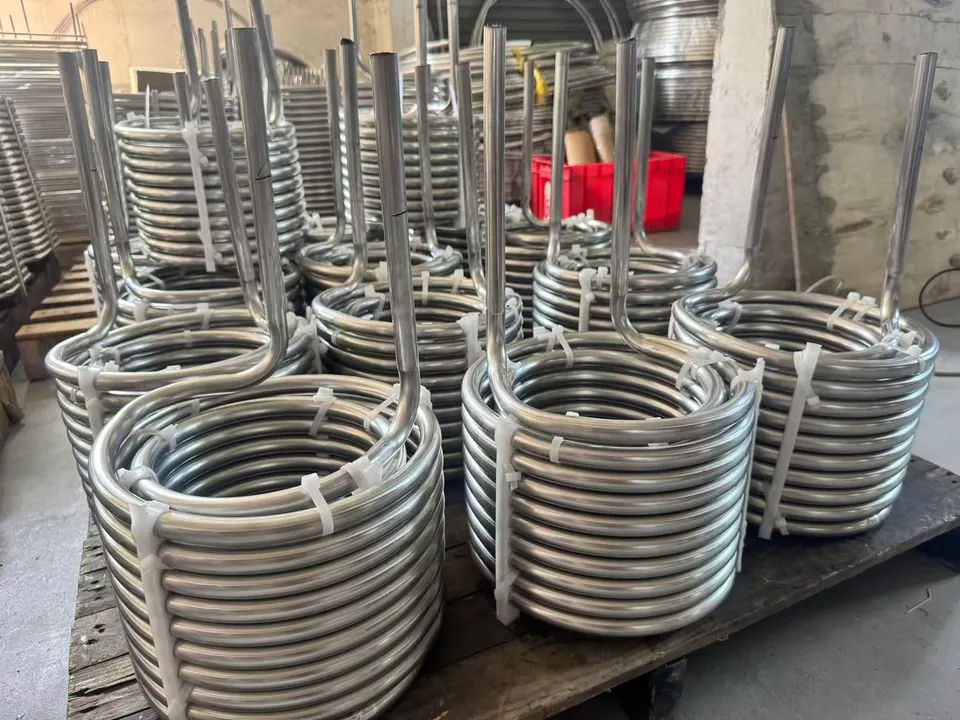
A helical coil is a tube formed into a helix of constant diameter, so a long length of tube fits inside a compact cylindrical space. It is defined by the coil outside diameter, the tube outside diameter and wall, the pitch between turns, the number of turns or overall height, and the position of the inlet and outlet legs. Uniinox forms helical coils in stainless steel or copper tube to the customer's drawing. The 2026 catalog documents 304 stainless references from 160 mm to 880 mm high with Ø9.52, Ø12 and Ø22 mm tube.
Dimensions to specify
Mark these dimensions on a sketch or drawing. Say which ones control the fit and which are only for reference.
| Symbol | Dimension | Notes |
|---|---|---|
| D | Coil outside diameter | Measured over the outside of the tube |
| H | Overall coil height | State whether the legs are included |
| d × t | Tube outside diameter × wall | For example Ø22 × 1.0 mm |
| P | Pitch | Centre-to-centre distance between neighbouring turns |
| N | Number of turns | Or give the height and pitch |
| L | Leg length and direction | Where the inlet and outlet leave the coil |
Where helical coils are used
A helix fits a long tube into a round space with even spacing between turns, so it suits immersion heating and cooling in cylindrical tanks and vessels, and compact equipment where the coil sits inside a housing. Research on coiled tubes also reports that the curvature sets up a secondary flow, known as Dean vortices, which improves radial mixing compared with a straight tube; Kováts et al. (2020) review this and note that in a plain helix the vortices form within the first few turns.
Related: Immersion coil heat exchangers, Tank heating and cooling coils
Catalog layouts
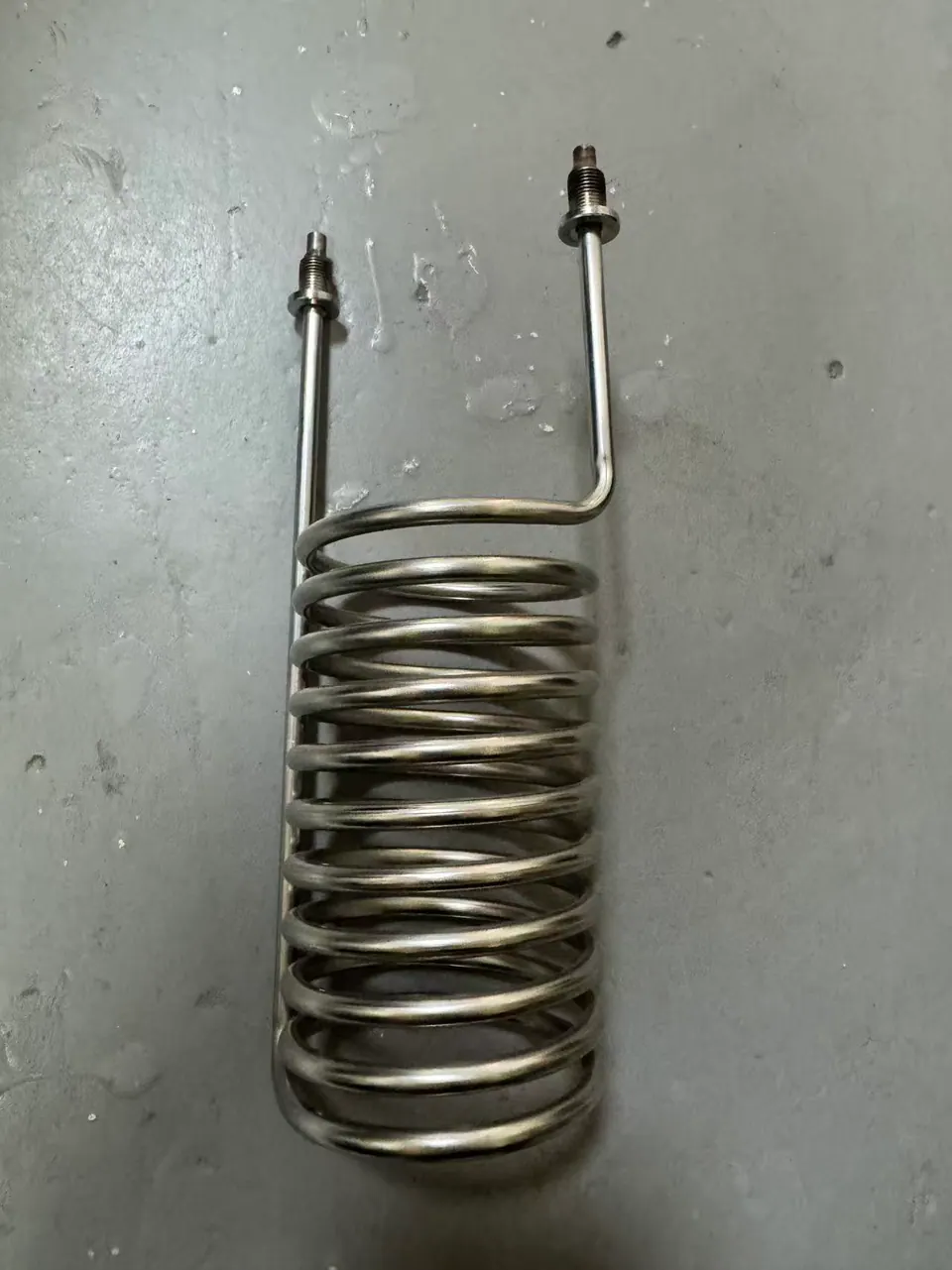
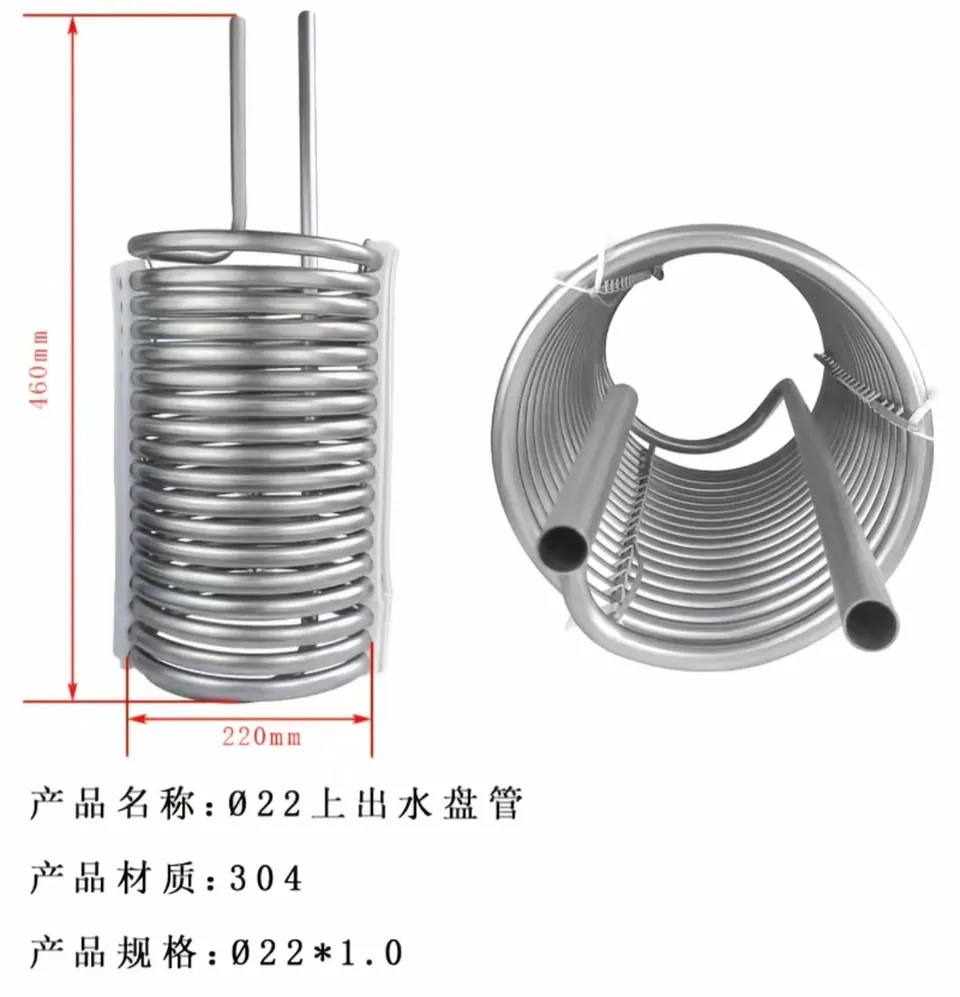
The custom coil catalog shows the helical layouts below in 304 stainless steel. They are references for a drawing review rather than fixed products: any diameter, height and tube size can be drawn to suit the space.
| Layout | Catalog references | Tube OD × wall |
|---|---|---|
| Single-circuit | P01, P05, P06, P08 | Ø22 × 1.0 mm |
| Dual-circuit | P02, P03 | Ø22 × 1.0 mm |
| Top-connection | P04 | Ø22 × 1.0 mm |
| Compact | P07 | Ø9.52 × 0.7 mm |
| Tapered | P09 | Ø12 × 0.8 mm |
Related: Custom coil catalog, Dual-circuit coils, Tapered coils
Pitch, turns and connection legs
If neighbouring turns must not touch, the pitch has to be larger than the tube outside diameter. The gap between turns also affects how the liquid moves around the coil and how the outside is cleaned, so state the minimum gap you need.
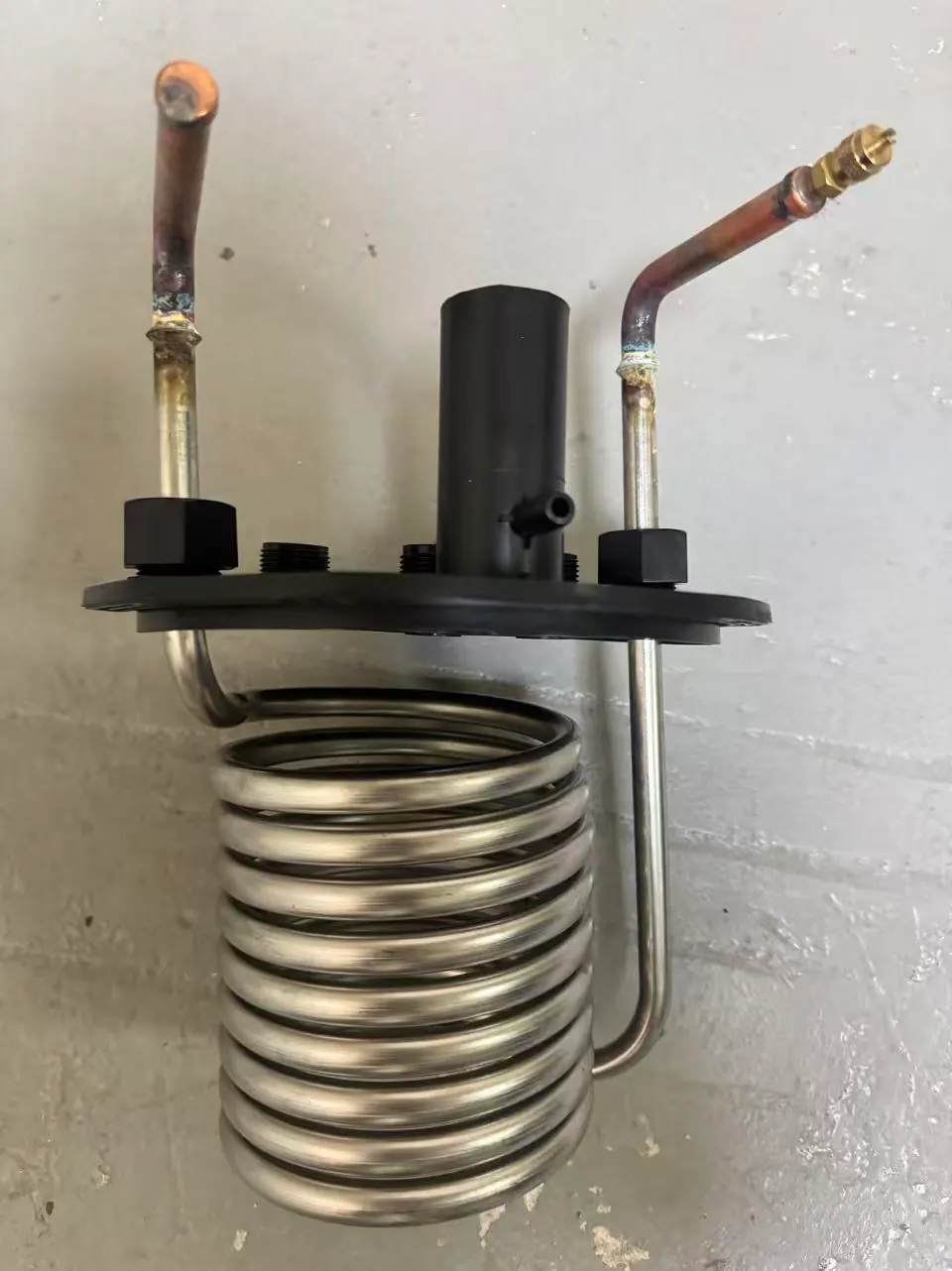
Show where the inlet and outlet must leave the coil, how long the legs are, the end type and any supports or mounting plate. A top-connection layout brings both ends out at the top, which suits a vessel that is only accessible from above.
Tube length
L = N × √((π × (D − d))² + P²) + legs
D − d is the centreline (mean) coil diameter. Each turn unrolls into the hypotenuse of a triangle whose sides are the centreline circumference and the pitch. The result is the coil length only; connection ends and forming allowances add to the tube that is cut.
Production and catalog photos
What to send for a quotation
A dimensioned sketch is enough to start. Photos of the space or of an existing coil help if you do not have a drawing.
- Coil outside diameter, overall height, pitch or number of turns
- Tube material, outside diameter and wall thickness
- Working medium inside the tube and the liquid or air outside it
- Operating temperatures and pressure, and any test requirement
- Connection ends, direction and length of the legs, and supports
- Quantity and any packing or cleanliness requirement
Frequently asked questions
Questions about helical coils
What is the difference between a helical coil and a spiral coil?
A helical coil keeps the same diameter and rises along its axis, like a spring. A flat spiral, or pancake, coil stays in one plane and its diameter grows with each turn.
Can a helical coil be made from copper tube?
Yes. Uniinox forms copper tube coils to drawing as well as stainless coils. The copper grade, outside diameter, wall and temper are confirmed for the project.
Do I have to choose a catalog size?
No. The catalog references P01 to P09 are starting points. The coil is made to the dimensions on your drawing.
Primary sources
Technical references
- Mixing characterization in different helically coiled configurations by laser-induced fluorescenceKováts et al., Experiments in Fluids 61, 203 (2020)
Reviews how Dean vortices in helically coiled tubes improve radial mixing and heat and mass transfer compared with straight tubes, and reports that in a plain helix the vortices form within the first few turns.