Quick answer
In short
A conical or tapered coil is a helical coil whose diameter increases or decreases steadily from one end to the other, so its outline is a cone. It is defined by the outside diameters at both ends, the height, the pitch or number of turns, the tube size and the connection legs. It is used where the space itself is tapered, such as the conical section of a vessel. The Uniinox catalog documents a 304 stainless tapered reference, P09, with Ø12 × 0.8 mm tube, 260 mm high, tapering from 80 mm at the bottom to 120 mm at the top; other tapers are made to the customer's drawing.
Dimensions to specify
Mark these dimensions on a sketch or drawing. Say which ones control the fit and which are only for reference.
| Symbol | Dimension | Notes |
|---|---|---|
| D_top | Outside diameter at the top | Measured over the tube |
| D_bottom | Outside diameter at the bottom | Measured over the tube |
| H | Overall coil height | State whether the legs are included |
| P or N | Pitch or number of turns | Constant pitch unless stated |
| d × t | Tube outside diameter × wall | For example Ø12 × 0.8 mm |
Where conical coils are used
A cone-shaped space, such as the bottom section of a vessel, leaves a straight helical coil either too small at the top or too large at the bottom. A tapered coil follows the slope, so the gap between the coil and the wall stays even from top to bottom.
Specifying the taper
Give the outside diameter at both ends and the height, and say whether the diameters are measured over the tube or to its centreline. A steady taper with constant pitch is the usual default; if the turns must follow a particular profile, show it on the drawing.
Related: Custom coil catalog (reference P09)
Tube length
L ≈ N × √((π × ((D_top + D_bottom) / 2 − d))² + P²) + legs
Uses the average centreline diameter; for a steady taper this is a close estimate. The result is the coil length only; connection ends and forming allowances add to the tube that is cut.
Production and catalog photos
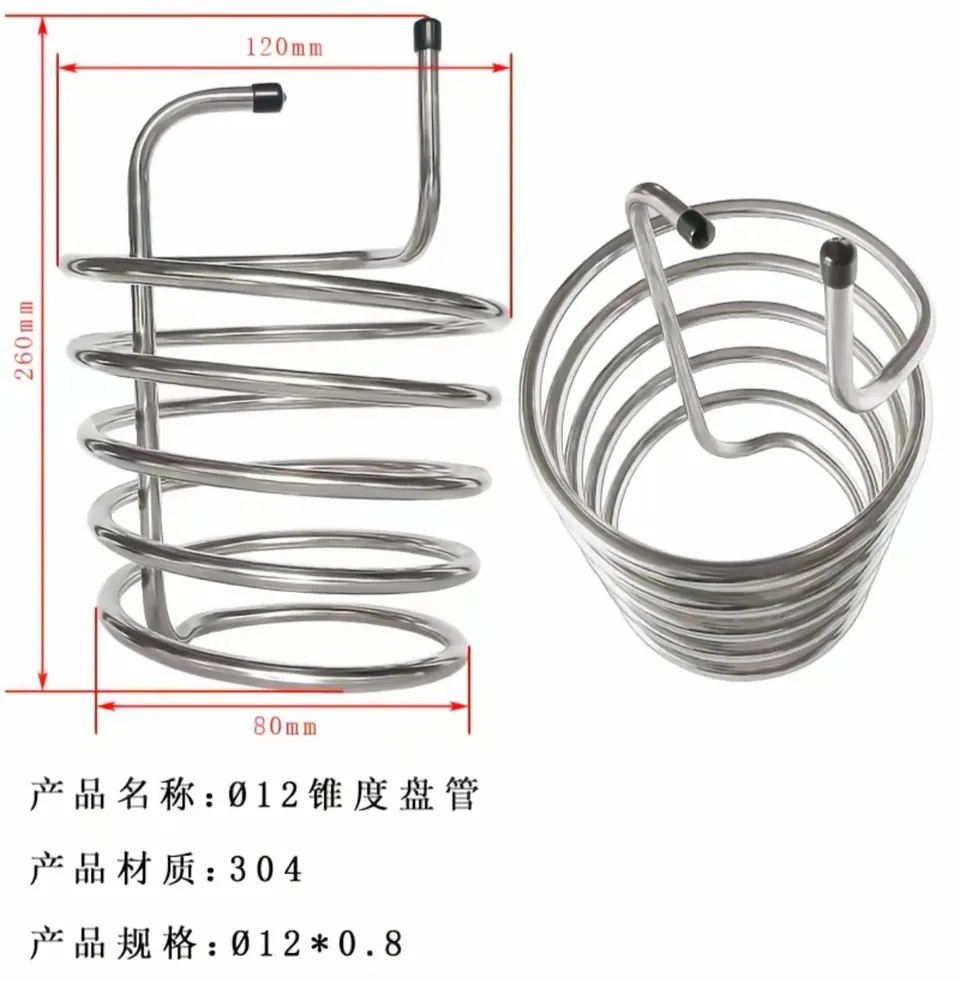
What to send for a quotation
A dimensioned sketch is enough to start. Photos of the space or of an existing coil help if you do not have a drawing.
- Top and bottom outside diameters, height and pitch or number of turns
- Tube material, outside diameter and wall thickness
- Working medium inside the tube and the liquid or air outside it
- Operating temperatures and pressure, and any test requirement
- Connection ends, direction and length of the legs, and supports
- Quantity and any packing or cleanliness requirement
Frequently asked questions
Questions about conical (tapered) coils
What is a tapered coil?
A tapered or conical coil is a helical coil whose diameter changes steadily from one end to the other, so it can follow a cone-shaped wall.
Which diameters should I give for a conical coil?
The outside diameter at the top and at the bottom, the height and the pitch or number of turns. Say whether the diameters are measured over the tube or to its centreline.
Can the coil be wider at the top or at the bottom?
Either. The catalog reference P09 is wider at the top; the direction of the taper follows your drawing.