Quick answer
What this guide covers
How to choose and specify a stainless or copper coil for heating or cooling liquid in a tank or vessel: coil shape, placement, heating or cooling medium, drainage, cleaning access and the inputs needed for a quotation.
Choose the coil shape to suit the tank
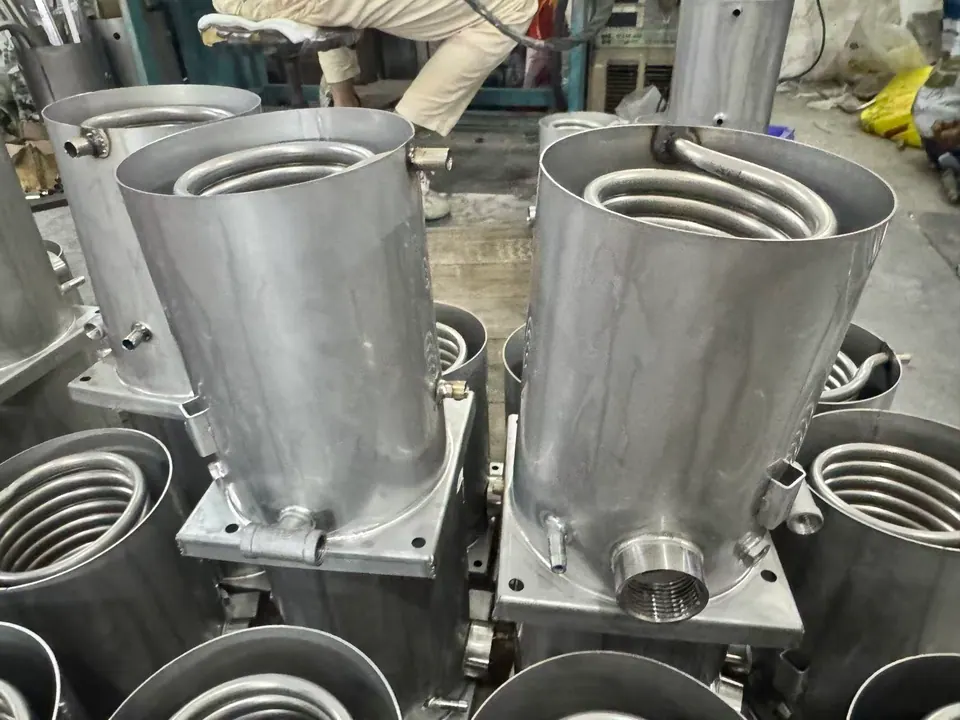
The coil shape follows the tank geometry, the access opening and what else is inside the vessel.
| Coil shape | Suits | Notes |
|---|---|---|
| Helical | Round tanks and vessels | Can sit around a central agitator or drain |
| Rectangular | Rectangular tanks and baths | Follows the walls and leaves the centre free |
| Tapered | Conical tank sections | Catalog reference P09 |
| Compact | Small vessels and equipment | Catalog reference P07 |
| Dual-circuit | Larger duties in a limited height | Splits the flow into two parallel paths |
Related: Immersion heating and cooling coils, Custom coil catalog
Decide where the coil sits
Bottom-mounted coils are common, but side-hung coils are easier to install and remove for cleaning. Spirax Sarco notes that side-hung coils are often used in electroplating tanks for this reason, and that with corrosive solutions the inlet and outlet should pass over the tank lip rather than through the wall or lining.
Give the coil enough coverage of the liquid for heat to spread through the bulk, and leave clearance for agitators, level probes, drains and the parts or baskets that go into the tank.
Steam, hot water or a cooling medium
Steam coils need a gradual fall from inlet to outlet so condensate drains, and lifts should be avoided where possible to prevent waterhammer. If the coil heats with steam, state the steam pressure and how condensate leaves the coil.
For hot water, thermal oil, chilled water or glycol, state the flow rate, inlet and outlet temperatures and the allowable pressure drop. Long single circuits can create a high pressure drop; a dual-circuit coil, which splits the flow into two parallel paths, is one way to reduce it.
Estimate the surface area from the duty, not from a photo
The required coil surface follows from the heat load, the temperature difference between the two fluids and the overall heat transfer coefficient. That coefficient changes widely with the liquid and with agitation: Spirax Sarco gives recommended values of about 550 W/m²·°C for steam coils below 2 bar g in water with natural circulation, about 1,100 W/m²·°C with assisted circulation, and around 80 to 110 W/m²·°C for heavy oils with natural convection.
Because of this range, send the heating or cooling duty or the batch time and temperatures, the liquid volume and properties, and whether the tank is agitated. Spirax Sarco also suggests adding about 10% to the calculated area to cover uncertainty in the coefficient and future fouling.
Material, cleaning and removal
Stainless steel is the usual starting point for food, beverage and many process liquids; copper suits many water and glycol services but not ammonia or liquids that attack copper. If the tank liquid can foul the surface, decide whether the coil must be removable and how it will be cleaned.
Supports, connections and installation
Show how the coil is supported in the tank, where the connections leave the vessel and the path the coil must follow through the access opening. Supports should hold the coil without trapping dirt and should allow for thermal movement.
If the coil is mounted on a flange or cover plate, include the plate dimensions, bolt pattern and connection positions on the drawing.
What to send for a quotation
A drawing is best. If you do not have one, send the tank dimensions and photos with the information below, and use the coil measurement worksheet to organise it.
- Tank shape, inside dimensions, liquid level and access opening
- Liquid in the tank, its temperatures and whether it is agitated
- Heating or cooling medium, pressure, flow and temperatures
- Required duty or batch heating or cooling time
- Preferred material, connection type and position, supports
- Quantity and required inspection documents
Frequently asked questions
Project questions
Should I use a helical or a rectangular coil in my tank?
Use the shape that follows the tank: helical coils suit round tanks and vessels, rectangular coils suit rectangular tanks and baths. The access opening and internal fittings also affect the choice.
How do I know how much coil surface I need?
The surface area is calculated from the heat load, the temperature difference and the overall heat transfer coefficient, which depends strongly on the liquid and agitation. Send the duty and operating conditions so the area can be reviewed.
Can the coil be removed for cleaning?
Yes, if the coil and tank are designed for it. Side-hung coils and coils on a removable cover plate are common ways to allow removal; show the access opening on the drawing.
Can Uniinox supply the coil together with the vessel?
Coil-only supply is the usual starting point. Coils integrated with a vessel, headers or mounting plates can be reviewed as an OEM assembly enquiry.
Primary sources
Technical references
These references support the general selection principles above. They do not certify a Uniinox product or replace the approved project design.
- Heating with Coils and JacketsSpirax Sarco
Guidance on submerged coil placement, side-hung coils, drainage of steam coils, typical overall heat transfer coefficients and an area allowance for fouling.
- Heat Exchangers, Chapter 47ASHRAE Handbook—HVAC Systems and Equipment, 2024
General guidance on heat-exchanger inputs, materials, fouling, pressure drop and cleaning access.
- Role of Stainless Steels in Industrial Heat Exchangers, No. 9005Nickel Institute
Application-specific stainless material and corrosion considerations.