Quick answer
In short
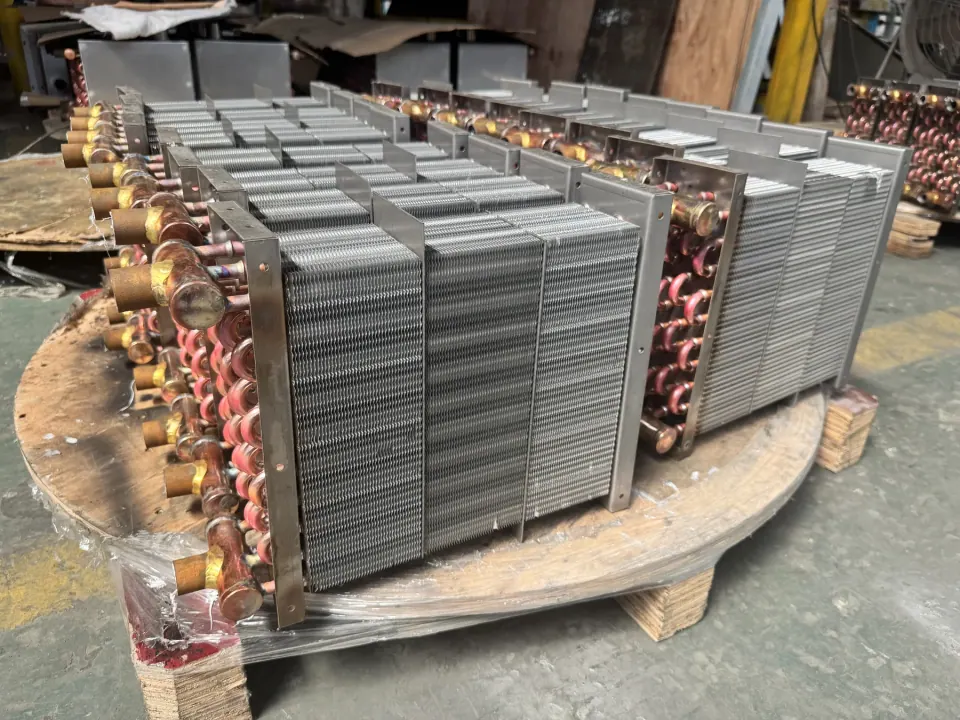
Refrigeration coils are finned-tube heat exchangers on the low-pressure (evaporator) and high-pressure (condenser) sides of a refrigeration circuit. Evaporators for freezers use wider fin spacing than evaporators for coolers because frost builds on the fins, and the defrost method affects how the coil is built. Condensers are sized for the heat rejected at the design ambient. The refrigerant sets the design pressure and limits the tube material: ammonia, for example, attacks copper. Uniinox supplies copper-tube finned condenser and evaporator cores made to drawing; refrigerant, duty and test pressure are confirmed for each project.
Key facts at a glance
Typical values from published references. Your system designer's figures take priority.
| Topic | Typical guidance | Source |
|---|---|---|
| Low-temperature evaporators | About 4 fins per inch, no more than 6 | ACHR News |
| Medium- or high-temperature evaporators | 6 to 8 or more fins per inch | ACHR News |
| Frost | Coil surfaces run below 0 °C even in a 1–2 °C chilled room, roughly −5 to −1 °C | ACHR News |
| Defrost methods | Off-cycle (rooms above 0 °C only), electric or hot gas | ACHR News |
| Ammonia (R717) | Attacks copper; lines and heat exchangers in steel or stainless steel | BITZER |
| Unit cooler ratings | AHRI 420/421 covers specific forced-circulation free-delivery unit coolers | AHRI |
Evaporator or condenser: where each coil sits
The evaporator coil sits in the cold room or process and absorbs heat as refrigerant evaporates in its tubes. The condenser coil sits on the high-pressure side, usually outdoors or in a plant room, and rejects that heat, plus the work added by the compressor, as the refrigerant condenses. Both are often copper-tube finned cores, but their pressures, temperatures and air conditions differ, so they are specified separately.
Related: Evaporator coil vs condenser coil, Industrial evaporator coils, Industrial condenser coils
Room temperature decides fin spacing
Evaporator surfaces run below the freezing point of water even when the room is above it. ACHR News gives the example of fresh meat held at 1 to 2 °C, where the coil surface falls to roughly −5 to −1 °C and frost forms. Frost insulates the fins and blocks the air passages, so low-temperature evaporators use wider fin spacing: typically about 4 fins per inch and no more than 6, against 6 to 8 or more for medium- and high-temperature evaporators.
Fewer fins per inch means a physically larger evaporator for the same capacity, so the room or process temperature has to be fixed before the coil size.
| Fins per inch | Fin pitch | Typical evaporator use (ACHR News) |
|---|---|---|
| 4 FPI | 6.4 mm | Low temperature, typical |
| 6 FPI | 4.2 mm | Upper limit for low temperature; lower end for medium temperature |
| 8 FPI | 3.2 mm | Medium or high temperature |
Defrost method changes the coil construction
Off-cycle defrost stops refrigeration while the fans keep running, and it only works where the room air is above 0 °C (32 °F). Below that, electric defrost uses heaters run through passages in the fins, and hot-gas defrost sends hot discharge gas through the coil tubes; ACHR News describes reverse-cycle hot gas as the primary method in supermarkets.
Electric heaters need their own passages in the fin pack and hot gas changes the piping, so state the defrost method, and the drain arrangement, in the enquiry.
Refrigerant, pressure and tube material
The refrigerant sets the saturation pressures the coil must hold and the materials it can use. BITZER's refrigerant data states that ammonia (R717) attacks copper materials, so ammonia lines and heat exchangers are made of steel or stainless steel. ISO 5149-1 sets out how refrigerating systems are classified and selected for safety, which is another reason the refrigerant and system type belong in the enquiry.
Do not assume that a coil built for one refrigerant suits another. State the refrigerant, the maximum allowable pressure and the test pressure required.
Condenser coils: design ambient and environment
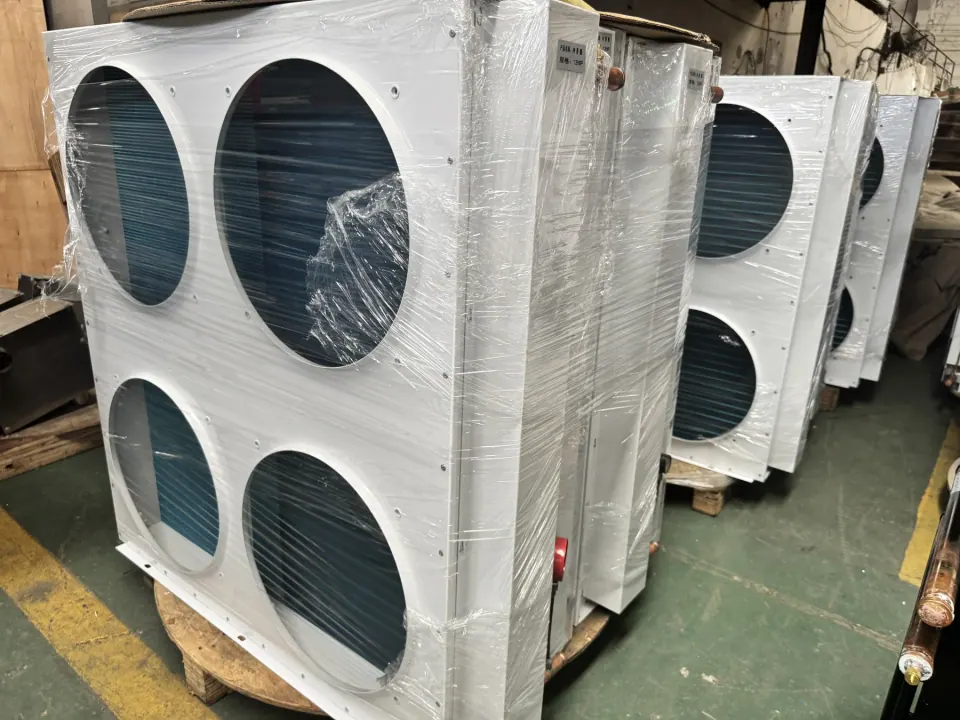
A condenser coil is sized to reject the system's heat at the highest air temperature it has to work in, so give the design ambient rather than a typical day. Note the installation environment too: coastal, industrial or washdown locations can call for a coating or a different fin or tube material. Coated coils are available as a project option; the coating type is agreed for each order.
What to send for a quotation
The list below is the minimum for a first technical review. Photos, sketches or a size list help if you do not have a complete drawing yet.
- Refrigerant and system type
- Required duty and the evaporating or condensing temperature
- Room or process temperature, and air on and off the coil
- Airflow, and whether fans and casing are part of the supply
- Defrost method, drainage and fin spacing limits for evaporators
- Design ambient and installation environment for condensers
- Envelope, connections, maximum allowable pressure, test pressure, coating and quantity
Frequently asked questions
Questions about this application
Why do freezer evaporators have fewer fins per inch?
Frost builds on the fins and blocks the airflow. Wider spacing gives the frost somewhere to collect between defrosts. ACHR News gives about 4 fins per inch, and no more than 6, as typical for low-temperature evaporators, against 6 to 8 or more for medium- and high-temperature units.
Can a copper-tube coil be used with ammonia?
No. BITZER states that ammonia (R717) attacks copper materials and that lines and heat exchangers should be steel or stainless steel. Always state the refrigerant in a coil enquiry.
Which defrost method should I specify?
That is a system decision. Off-cycle defrost only works for rooms above 0 °C; electric and hot-gas defrost are used for lower temperatures. Because each method affects how the coil is built, state the chosen method in the enquiry.
Does Uniinox publish rated capacities for refrigeration coils?
No. Product pages do not publish ratings. Capacity is reviewed against your operating data for each project. If your project requires an AHRI-certified unit cooler, state that requirement in the RFQ.
Primary sources
Technical references
These references support the general points above. They do not certify a Uniinox product or replace the approved project design.
- Frost and Defrost: How It Happens and Why It Is Needed – A White PaperACHR News, 5 September 2011
Gives typical evaporator fin spacing of about 4 fins per inch (no more than 6) for low temperature and 6 to 8 or more for medium or high temperature, and describes off-cycle, electric and hot-gas defrost.
- General chemical and physical properties of R717BITZER
States that R717 attacks copper materials and that lines and heat exchangers should be steel or stainless steel.
- AHRI 420/421-2023: Performance Rating of Forced-Circulation Free-Delivery Unit CoolersAir-Conditioning, Heating, and Refrigeration Institute
Scope and standardized rating basis for the covered unit-cooler categories; not a universal custom-exchanger certification.
- ISO 5149-1:2014: Refrigerating systems and heat pumps, safety and environmental requirements, Part 1International Organization for Standardization
Sets out how refrigerating systems and heat pumps are classified and selected; relevant when an enquiry states the refrigerant and the system type.